Beyond the Template: Reclaiming Design in an AI-Driven World
- Michael Bigos
- Apr 23
- 10 min read

In a world of pixel-perfect automation, design reasoning has become the ultimate competitive advantage.
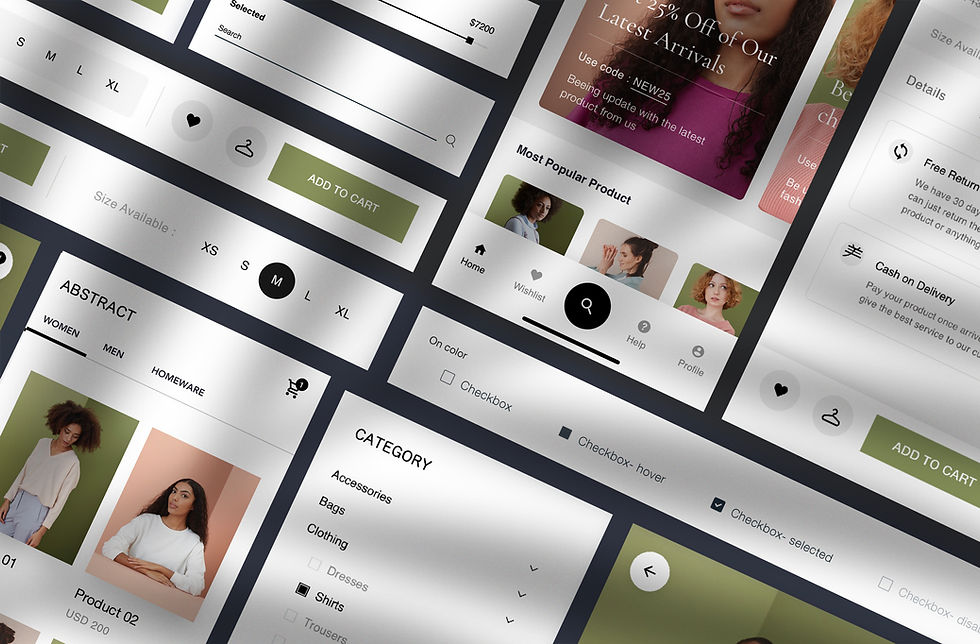
There's a difference between knowing how to design and knowing how to use a tool that designs for you. That distinction used to be obvious. It's not anymore. We are living in the golden age of design acceleration; Figma components, Framer templates, Canva kits, Webflow clones, AI-generated UI, pre-built design systems that can take you from blank canvas to polished prototype in under an hour. These tools are extraordinary. They've democratized design, lowered the barrier to entry, and put professional-looking output in the hands of people who ten years ago couldn't have built anything close.
And that's exactly the problem.
Where Design Actually Begins
Before I ever touched a computer, I was making things with my hands. Sculpture. Calligraphy. Paint. Pencil. The fine arts were my first design school, and what they taught me had nothing to do with software and everything to do with process. Even in college, the first semester of the curriculum didn't have one computer in the class. Easels, rulers, t-squares and rubber erasers were mastered before the mouse was. Standing in front of a blank canvas with only an idea is one of the most uncomfortable and clarifying experiences a creative person can have. You can't drag and drop your way out of it. You can't browse a template library. You have to reason your way forward making decisions about form, proportion, weight, contrast, and meaning with every mark you make.
It's also where I discovered what I'd come to understand as my core superpower as a designer: the ability to take something vague — a half-formed idea, a fuzzy business objective, a client who knows what they feel but not what they want and translate it into something tangible, precise, and visually compelling that moves people and moves business. That translation ability doesn't come from a template. It comes from years of wrestling with the blank canvas and learning to trust the process of getting there.
The Template Economy
Let me be clear about what I'm not saying. Templates are not evil. Expediting your workflow with pre-built components, design systems, and scalable UI libraries is smart work — not lazy work. Experienced designers use templates every day. The difference is that a experienced designer knows why they're choosing a template, when to deviate from it, and what it communicates to the person on the other end of the screen.
What I am saying is this: if leveraging templates is all you know, you don't actually know design. You know how to fill in the blanks...like a digital by-the-numbers coloring book.
The design industry is quietly producing a generation of practitioners who are extraordinarily good at filling in blanks and who have never been asked to stare at a white canvas and reason their way to a solution from first principles. They've never had to ask themselves: What does this color do to the viewer emotionally? Why does this typeface feel authoritative versus approachable? What does the eye do when it lands here and where do I want it to go next?
Color theory. Visual hierarchy. Typographic rhythm. Negative space. Balance, not just aesthetic balance, but informational balance. These are not design school artifacts. These are the foundational forces that make design actually work. They are not things you absorb by dragging components into a Figma frame.
Templates can absolutely help expedite decisions. But the decisions have to first be known, understood, and made. A template cannot make the strategic call for you. It can only execute a call you've already reasoned through. When the reasoning never happens, the template isn't a shortcut — it's a substitute for thinking. Sure inspiration and ideas can be derived from browsing through templates and UI kits, however, I've found many problems I was asked to solve were not buried within stock or template libraries. They were found in the messy-middle of real problem-solving.
The Portfolio Problem
Here's where it gets complicated for businesses, hiring managers, and design teams.
The portfolio has become a gallery of wow. Scroll any design portfolio today and you'll be dazzled. Glassmorphism. Bento grid layouts. Kinetic typography. Micro-animations that feel like they belong in a Pixar film. The work looks extraordinary. It's visually stunning. And in many cases, it is genuinely impressive on its own terms.

Many young designers coming up right now have exceptional eyes. They've grown up saturated in visual culture, they've absorbed the trends, the apps, and within minutes they can produce aesthetically sophisticated work that would have turned heads in any era. That's real. That deserves acknowledgment.
But an eye for aesthetics is only one dimension of what design actually requires in practice.
Because as stunning as that portfolio looks in a presentation and it does look stunning — it tends to open doors to a set of questions the portfolio-work alone often can't answer. How much will this cost to build? What's the timeline to deployment? Who are the stakeholders, and have their constraints been factored in? What happens when the brand team pushes back, or the dev team says the animation isn't feasible, or the budget gets cut in half?
These are the real rooms where design lives or dies. And beautiful work that can't survive those rooms isn't finished work, it's a concept.
Ask the designer a few questions...
Why did you use that typeface pairing? "It just felt right."
Why is this CTA positioned here? "The template had it there and it looked clean."
What business problem were you solving? "The client wanted something modern."
Is this truly 508 and ADA compliant? "I will double check."
The portfolio screams wow. The conversation reveals the absence of why.
Business owners, decision-makers, and designers who chase the wow are unknowingly building design or design teams that can produce beautiful deliverables but cannot defend them in a room. Furthermore, noice designers are 'trending' with their creativity but lack fundamental design-discipline at the perrile of the business. And because, the rate at which information travels today, there's little to no immediate consequence to otherwise 'bad design' or 'bad design process'. At least so it seams in the short term. Fast forward a month or six months and when looking to measure outcomes and impact of design decisions, there's a glaring void the business has to face. It's where business-decisions have to be made.
Teams that can make something look incredible but fault when a stakeholder asks: "How does this solve our problem? How does this increase our revenue; decrease our overhead?" It's these hard yet reasonable questions I was faced with as a designer which ultimately forced me to shift my approach to design, my thinking around how design should work - in addition to how design looks.
Design without reasoning is decoration. Expensive, beautiful, indefensible decoration. We are NOT in the 'art gallery' business; We use design to solve business-problems.
What Getting Forged Actually Looks Like
I came up through design the hard way which at the time just felt like the only way.
We wanted to make cool things. All of us. We chased the aesthetic high. We studied the annuals, obsessed over award-winning campaigns, tried to out-art each other. That energy is real and it matters. The desire to create something that stops people cold is not a flaw, it's a feature. It's the fire that makes great designers great.
But something shifts when you move into rooms where real problems need real solutions. I found myself in those rooms — sitting across from business leaders who weren't asking for beautiful. They were asking for effective. They had customers who were confused, revenue that was bleeding, a brand that wasn't converting, a digital product that users abandoned after thirty seconds. They didn't need wow. They needed clarity. They needed results that both worked well and looked good; fast. Always fast.
I had to stop asking What would look incredible here? and start asking Who is sitting on the other side of this experience? What do they need to feel, understand, and do? What is the one thing this design must accomplish, and is everything else in service of that thing? Can I or my team produce the solution with expediency and efficiency without sacrificing 'good design' in the process? Often, I was able to accomplish the latter. Sometimes, the mountain is a slippery-slope which required more calculated strategy and execution.

My fine arts background became unexpectedly essential in those moments. Not because I was sculpting or painting but because that training had conditioned me to think through a problem before committing to an execution. To understand process. To hold a vague intention in mind and work deliberately toward something concrete and resolved. Yes, I'd be lying if I said this all came to me without the use of templates. However, I trained my mind to sift through images, ideas, and prior concepts I'd seen as if I was a human Google Images search. My templates were cerebral more often than libraries.
That same muscle, translating the ambiguous into the tangible turned out to be exactly what business design demands.
I’ve spent my career leaning into the 'other side of the coin'—engaging with development, merchandising, and distribution to sharpen my strategy. I gathered every insight possible because I learned early on that you cannot deliver precision at the pixel level if you don't understand the problem at the business level. I used to be settled in the design, not the problem. I relied on my ability to 'wow' my counterparts, but I quickly found that aesthetic charm has a short shelf life in a high-stakes environment. After seeing my curated concepts undergo significant deviations, I knew my influence was slipping. I had to change. By leaning into the business of design rather than just the art of it, I found a level of alignment and trust that 'beautiful' work alone could never achieve.
Sometimes the answer was bold and expressive. Other times it was minimal and direct.
The common thread was never the aesthetic. It was the reasoning; the mission. This reasoning should come from the roots, the foundational practitioning of understanding the problem, scope, audience and yes, the business.
In Defense of Whimsy
None of this is an argument against creative expression. Not even close.
The ability to design something genuinely appealing, unexpected, and whimsical is a rare and valuable asset. I too, are still wowed by the beautiful campaign. The designers who can break convention — who can create visual experiences that feel alive, surprising, and memorable are not a dime a dozen. That skill deserves to be celebrated, cultivated, and valued. Hire them! You may have found a Unicorn.
The issue is not that whimsy exists. The issue is knowing when it serves the work.
A playful, maximalist interface might be exactly right for a children's wellness app, a boutique creative agency, or a festival brand. It might be catastrophically wrong for a healthcare patient portal, a legal services platform, or a B2B enterprise tool where the stakes of confusion are high.
The question is never Can I design something that looks like this?
The question is always Should I? And why?
Designers who have never worked from first principles often can't answer that question. Not because they lack talent and admit, they clearly have an eye. But because they've been handed the what without ever being asked to wrestle with the why. The root is where things begin. It's a little 'dirty' however, it's rewarding to get dirt under your fingernails when unearthing the root of the problem and the root of where the solution begins.
In practice, it's the going beyond the 'obvious' in discovery. Every business exists to make money. This is a "what." The magic happens when you can discover the "why" a business began in the first place. What's the business's ethos? When a designer can extrapolate this from the business, the stars can align and the real designing can begin.
What the Industry Should Be Asking
To business owners, decision-makers, leads, and hiring managers building design teams: stop letting the portfolio end the conversation. With AI in the midst, a portfolio proves that someone can execute visually. Your vetting should prove they can think; hard...efficiently.
Ask them to walk you through design decisions that challenged them. Ask them what it would cost to build what they're showing you and lean in to the answer. Ask them to explain how they'd approach designing for a customer who completely contrast to them.
Ask them: If I took every template off the table and gave you a blank canvas and a business problem, where would you start? The answers will tell you everything. The answer may even reveal some blind spots in your business model.
To design educators and mentors: build the foundation first. Let young designers feel the discomfort of the blank canvas before you hand them a mouse or component library. Whiteboards, paper, and yes, even magic-markers are still valuable "design tools" that cultivate creativity and sift the ideas to clarity. Make them choose a typeface and justify it. Make them build a color palette from scratch and explain the emotional logic. Make them fail at a layout before they discover why the grid exists. Give them a business problem — not a design prompt — and see how they respond. An ideation-session is a truly rewarding experience when you can walk through the nuances of the customer-journey from browsing-to-checkout.
The tools will still be there when the fundamentals are solid. And a designer who understands both is genuinely valuable and powerful.
Be the Designer Who Can Survive the Room
Own the Canvas. Don't Just Fill the Blanks!
To the up-and-coming designers reading this: the templates are not your enemy. Use them. Learn from them. But never let them replace the harder discipline of knowing why design works. Learn color theory until it's instinct. Understand visual hierarchy so well that you can feel when it's broken. Understand copywriting and storytelling. Study human and customer behavior, not just visual trends. Not just social media echoes. Pick up a pencil before you open Figma or GAI applications. Get in the habit of asking why before you ask what.
Because companies will always chase the wow. But the designers who endure, the ones who build careers that actually matter are the ones who can walk into a room, look at a hard problem, explain the problem, and design their way to a real solution.
That skill doesn't come in a template. Now, go get dirty!
Michael K. Bigos is a brand strategist, UX/UI Leader, and digital transformation practitioner with experience spanning Fortune 500 environments, federal government, and entrepreneurial ventures. He is the author of "Branding That Works", available on Amazon. Connect on Linkedin >>


Comments